
The rise of IPTV has transformed how millions of people consume television content. But one feature that often gets overlooked in the excitement of endless channels and on-demand libraries is something deceptively simple — the IPTV schedule. Understanding how to use, read, and maximize your IPTV schedule is the difference between a frustrating channel-surfing experience and a smooth, organized viewing routine that puts you in full control of your entertainment.
Whether you are brand new to IPTV or a seasoned subscriber looking to get more out of your service, this guide covers everything you need to know about IPTV schedules. From what they are and how they work, to troubleshooting common problems and finding the best tools to manage them, this is your definitive resource on the topic.
Let us get started.
What Is an IPTV Schedule?
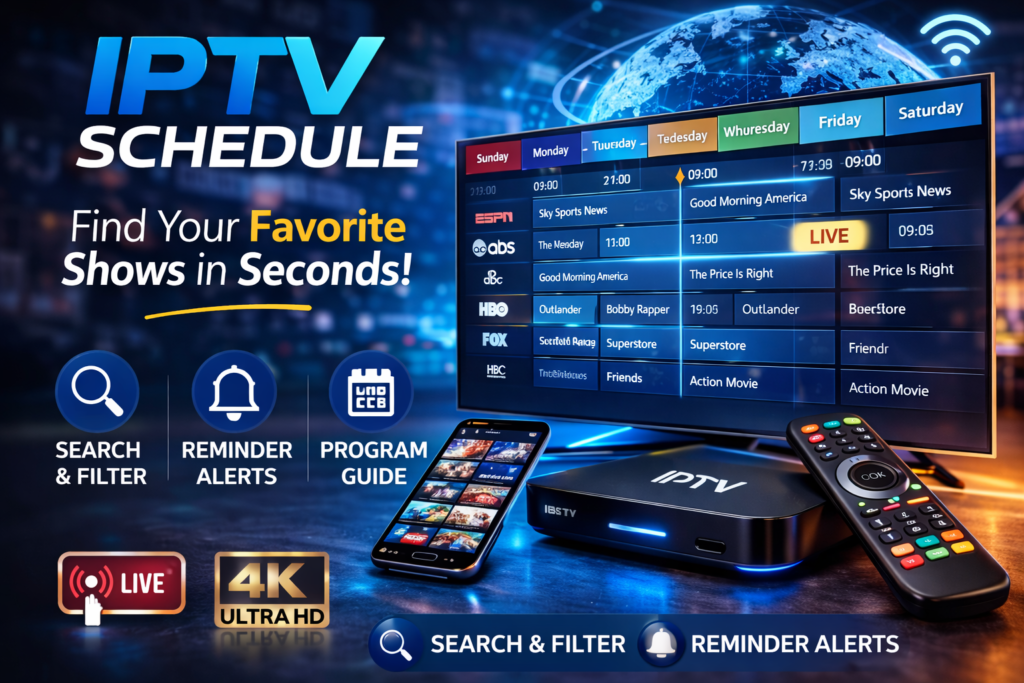
An IPTV schedule is a time-based program guide that displays what is currently airing and what is coming up across your IPTV channels. It is the digital equivalent of a traditional TV listings guide, but far more powerful, interactive, and packed with features that make navigating thousands of channels genuinely manageable.
In the IPTV world, the schedule is most commonly delivered through what is known as an Electronic Program Guide, or EPG. The EPG pulls real-time scheduling data from your IPTV provider and displays it in a grid or list format directly within your IPTV application. At a glance, you can see:
- What is currently playing on every channel
- What programs are scheduled to air next and throughout the day
- Program titles, descriptions, start times, and durations
- Genre categories to help you filter content by interest
- Upcoming live events such as sports matches, news broadcasts, and special programming
A well-functioning IPTV schedule turns a raw list of thousands of channels into a curated, navigable programming environment. Without it, finding what you want to watch across a large channel library would be an exercise in frustration.
Why the IPTV Schedule Matters More Than You Think
Most new IPTV subscribers focus almost entirely on channel count and stream quality when evaluating a service. The IPTV schedule tends to be an afterthought — until they actually start using their service daily and realize how central the schedule is to their entire experience.
Here is why the IPTV schedule deserves far more attention than it typically gets.
It Saves You Time
Scrolling through thousands of channels without a schedule is overwhelming and time-consuming. A good IPTV schedule lets you quickly scan what is on right now and what is coming up, so you can jump straight to the content you want without wasting minutes — or hours — searching.
It Helps You Plan Your Viewing
Just like a traditional TV guide, the IPTV schedule allows you to plan ahead. If a major football match is airing at 8 PM or a documentary you have been waiting for is premiering tonight, the schedule lets you see it in advance and plan your evening accordingly. For households with multiple viewers and competing interests, this planning function is invaluable.
It Enables Smarter Use of Catch-Up Features
Many IPTV services include catch-up TV functionality, which lets you watch programs that have already aired — typically up to seven days back. The IPTV schedule is your map for navigating those catch-up archives. Without a clear schedule showing what aired and when, using catch-up TV becomes guesswork.
It Makes Live Events More Accessible
Live sports, breaking news, award shows, and special broadcasts all depend on timing. The IPTV schedule ensures you always know when these events are starting, what channel they are on, and how long they are expected to run. Missing a live event because you did not know it was airing is entirely avoidable when you have a reliable IPTV schedule at your fingertips.
How Does an IPTV Schedule Work Technically?
Understanding the technical side of how an IPTV schedule functions helps you troubleshoot issues and make better choices when selecting a provider or application.
EPG Data Sources
The scheduling information that populates your IPTV guide comes from EPG data feeds. These are structured data files — typically in XMLTV format — that contain program information for each channel. Your IPTV provider either generates these feeds themselves or sources them from third-party EPG data providers.
The XMLTV format is the most widely used standard for IPTV scheduling data. It organizes channel programming into an XML file that your IPTV application reads and displays as a visual guide. The quality, accuracy, and update frequency of this data directly determines how useful and reliable your IPTV schedule is.
How Your IPTV App Reads the Schedule
When you open your IPTV application — whether that is TiviMate, IPTV Smarters Pro, GSE Smart IPTV, or another client — the app fetches the EPG data file from your provider and maps each program entry to its corresponding channel. This mapping process matches channel IDs in the EPG data to the channels in your M3U playlist, creating the visual grid or list schedule you see on screen.
Some IPTV applications update their EPG data automatically at regular intervals — typically every 12 to 24 hours. Others require you to trigger a manual refresh. Keeping your EPG data current is essential for maintaining an accurate, up-to-date IPTV schedule.
EPG Update Frequency
The freshness of your IPTV schedule depends entirely on how often the EPG data is updated. Premium IPTV providers update their EPG feeds multiple times per day, ensuring that last-minute schedule changes, breaking news coverage extensions, and live event overruns are reflected accurately. Lower-quality providers may only update EPG data once a day or less, which can lead to mismatches between what the schedule shows and what is actually airing.
Types of IPTV Schedule Formats
Not all IPTV schedules look or function the same way. Depending on your IPTV application and provider, you may encounter several different schedule display formats.
Grid View
The grid view is the most familiar format for anyone who has used a cable or satellite TV guide. Channels run vertically down the left side of the screen, while time slots run horizontally across the top. Program blocks fill the grid, showing what is airing on each channel at each time. This format is excellent for comparing what is on multiple channels simultaneously and is the default view in apps like TiviMate.
List View
The list view presents a single channel’s schedule as a vertical list of programs, showing each show’s title, start time, and duration in sequence. This format is ideal when you want to see the full day’s lineup for one specific channel — for example, checking the complete schedule for a sports network on a match day.
Now and Next View
The now-and-next view is a simplified format that shows only what is currently airing and what comes on immediately after, across multiple channels. It is a quick-glance format perfect for flipping between channels and making fast viewing decisions without diving into a full grid.
Mini Guide Overlay
Many IPTV applications display a mini guide overlay at the bottom or side of the screen while you are watching a channel. This allows you to browse the schedule without interrupting your current viewing. The mini guide typically shows the current program’s details and the next few upcoming programs on the same channel.
How to Set Up and Optimize Your IPTV Schedule
Getting the most out of your IPTV schedule requires a bit of initial setup. Here is how to configure it properly across the most popular IPTV applications.
Setting Up EPG in TiviMate
TiviMate is widely regarded as one of the best IPTV applications for Android TV and Fire Stick, and its schedule features are among the most polished available. To set up your IPTV schedule in TiviMate:
- Open TiviMate and navigate to Settings
- Select Playlists and tap your active playlist
- Under EPG, enter the EPG URL provided by your IPTV provider
- Set the EPG update interval — every 12 hours is a good default
- Tap Update EPG Now to load the schedule data immediately
- Return to the main guide to see your channels populated with schedule information
TiviMate’s guide view is highly customizable. You can adjust the time range displayed, change channel order, set favorites, and filter by category — all of which make navigating your IPTV schedule much faster and more intuitive.
Setting Up EPG in IPTV Smarters Pro
IPTV Smarters Pro is one of the most widely used IPTV clients and supports both M3U and Xtream Codes API connections. EPG setup is straightforward:
- Open IPTV Smarters Pro and go to Add User
- Enter your IPTV provider credentials or M3U URL
- In the EPG URL field, paste the EPG link from your provider
- Save and allow the app to load your playlist and schedule data
- Navigate to the Live TV section and select Guide to view the full schedule
Setting Up EPG in GSE Smart IPTV
GSE Smart IPTV is popular among iOS and macOS users and offers solid EPG support. After adding your M3U playlist, go to Remote Playlists, tap your playlist, and enter your EPG URL in the designated field. GSE will pull the schedule data and populate your guide automatically.
Common IPTV Schedule Problems and How to Fix Them
Even with a good IPTV provider and a well-configured app, IPTV schedule issues are among the most common complaints from subscribers. Here are the most frequent problems and their solutions.
Problem: EPG Shows Wrong Times
This is one of the most reported IPTV schedule issues, and it is usually caused by a timezone mismatch between the EPG data and your device’s local timezone setting. To fix this, open your IPTV application’s settings and look for an EPG timezone offset option. Adjust the offset in hourly increments until the schedule times match your local time accurately.
Problem: EPG Is Blank or Not Loading
If your IPTV schedule is completely empty despite having an EPG URL configured, the most likely causes are an incorrect EPG URL, an expired subscription that has cut off EPG data access, or a server-side issue with your provider’s EPG feed. Start by verifying the EPG URL directly in a browser — if it loads a data file, the URL is correct. If not, contact your provider for an updated link.
Problem: Channels Have No Schedule Information
Some channels in your IPTV lineup may show no schedule data even when others do. This typically happens because those specific channels are not mapped in your provider’s EPG data. International or niche channels are most commonly affected. Some IPTV applications allow you to manually assign EPG data to unmapped channels using third-party EPG sources — a feature called custom EPG mapping.
Problem: Schedule Data Is Outdated or Inaccurate
If your IPTV schedule is consistently showing incorrect program information — for example, listing a program that ended two hours ago as still airing — your EPG data is not updating frequently enough. In your IPTV application settings, increase the EPG update frequency and trigger a manual update. If the problem persists, your provider may be sourcing low-quality EPG data, which is a signal to consider switching to a provider with better schedule data infrastructure.
Problem: Schedule Disappears After App Restart
Some IPTV applications do not cache EPG data locally and re-fetch it from scratch every time the app is opened. On slower internet connections, this can cause a delay before the schedule loads, making it appear temporarily blank. Look for an option in your app’s settings to enable EPG caching or offline schedule storage, which keeps schedule data available immediately on startup.
Third-Party EPG Sources for Better IPTV Schedules
If your IPTV provider’s native EPG data is incomplete, inaccurate, or missing channels, third-party EPG sources can dramatically improve your IPTV schedule experience. Several reputable services aggregate programming data from broadcasters worldwide and provide it in XMLTV format compatible with all major IPTV applications.
EPGSHARE01 is a community-maintained EPG repository offering XMLTV data for a wide range of international channels. It is particularly strong for European, Middle Eastern, and North American content.
WebGrab+Plus is a powerful tool that scrapes program schedule data from broadcaster websites and generates custom XMLTV files. It requires some technical setup but offers exceptional accuracy and coverage for channels that mainstream EPG providers miss.
Schedules Direct is a subscription-based EPG service widely respected for its accuracy and reliability, particularly for North American channels. It integrates seamlessly with most major IPTV applications and is a popular choice among serious IPTV users.
When using a third-party EPG source, you will typically need to manually map each channel in your IPTV application to the corresponding EPG entry from the external data source. This process takes some time initially but results in a dramatically more accurate and comprehensive IPTV schedule.
IPTV Schedule and Sports: Getting Live Events Right
For sports fans, the IPTV schedule is not just a convenience — it is an essential tool. Live sports broadcasting is complex, with frequent last-minute schedule changes, extended coverage for extra time or rain delays, and simultaneous events across multiple channels.
Here is how to make the most of your IPTV schedule for sports viewing.
Setting Reminders for Key Matches
Most modern IPTV applications allow you to set reminders for upcoming programs directly from the schedule view. Navigate to the upcoming match in your EPG, select it, and choose the reminder option. Your app will alert you shortly before kickoff — or before any live event — so you never miss the start.
Using Multiple Connections for Sports Days
On days with heavy sports programming — weekend fixtures, playoff weekends, or tournament days — you may want to monitor multiple channels simultaneously. If your IPTV subscription includes multiple connections, you can run your IPTV app on a second device and use the schedule to track parallel events across different channels at the same time.
Accounting for Schedule Changes in Live Sports
Live sports are inherently unpredictable. Matches may start late, run into extra time, or be postponed entirely. The best IPTV providers update their EPG data in near real-time to reflect these changes, but it is always worth monitoring the schedule during major events to stay aware of any timing shifts.
How to Choose an IPTV Provider Based on Schedule Quality
When evaluating IPTV providers, schedule quality is a criterion that deserves serious weight. Here is what to look for.
EPG coverage depth. Ask the provider how many channels in their lineup have full EPG coverage. A provider covering 90% or more of their channels with accurate schedule data is significantly better than one with only 50-60% coverage.
Update frequency. Providers that update EPG data multiple times daily offer a more accurate, reliable IPTV schedule than those updating once every 24 hours. This matters most for news channels and sports networks where scheduling changes are common.
Timezone support. Quality providers offer EPG data in multiple timezone formats or include timezone configuration options in their supported apps. This ensures viewers in different regions all see accurate local times in their schedule.
Historical schedule depth. For subscribers who use catch-up TV regularly, having historical EPG data — showing what aired over the past seven days — is essential. Not all providers include retrospective schedule data in their EPG feeds, so confirm this feature explicitly if catch-up TV is important to you.
The Future of IPTV Schedules
As the IPTV industry continues to mature, the humble program schedule is evolving in some genuinely exciting directions.
Personalized schedule recommendations powered by artificial intelligence are beginning to appear in advanced IPTV platforms. Rather than displaying a generic grid of all available channels, AI-driven schedules surface the content most likely to interest you based on your viewing history, preferred genres, and watch patterns.
Voice-controlled schedule navigation is becoming increasingly common as IPTV applications integrate with smart home ecosystems. Asking your voice assistant to show tonight’s sports schedule or find what movies are starting in the next hour is quickly becoming a standard interaction model.
Real-time schedule synchronization is improving as IPTV providers invest in faster EPG pipeline infrastructure. The gap between a broadcaster updating their programming and that change appearing in subscriber schedules is shrinking from hours to minutes.
Integrated social scheduling features — where friends can share what they are watching, plan group viewing sessions, and sync schedules — are emerging as the next frontier for IPTV platform development.
Final Thoughts: Make Your IPTV Schedule Work for You
The IPTV schedule is one of those features that quietly underpins everything else about your streaming experience. When it works well, you barely notice it — it is simply always there, always accurate, always helpful. When it works poorly, it becomes one of the most irritating aspects of using an IPTV service.
The good news is that you have more control over your IPTV schedule experience than you might think. Choosing a provider with strong EPG infrastructure, selecting a well-designed IPTV application, configuring your schedule settings correctly, and supplementing with third-party EPG data where needed all combine to give you a program guide that genuinely rivals — and often surpasses — anything available on traditional cable or satellite television.
Take the time to set up your IPTV schedule properly from the start. Explore the guide features in your chosen application. Set reminders for the shows and events you care about. And if your current provider’s EPG data is consistently poor, treat that as a signal to find a better service — because in a competitive IPTV market, accurate and comprehensive scheduling is a baseline expectation, not a luxury.
The best IPTV experience is an organized one — and a great IPTV schedule is what makes that organization possible.